

 Building Configurator
 Request a Quote

Covering a Tennis Court: What Clubs Need to Know Before They Build
Outdoor tennis courts lose more playing hours to weather than most clubs like to admit. Rain stops play outright, and even a damp surface is enough to shut a court for safety reasons. If you're weighing up how to protect court time — and the revenue that comes with it — a tennis court canopy is worth understanding properly before you commit to a spec.
Here's what actually goes into one, and the questions worth asking before you order.
Why cover a court instead of building a hall?
A fully enclosed tennis hall gives you complete environmental control, but it's a different order of project — different construction, different services, different planning scope, and a much bigger budget.
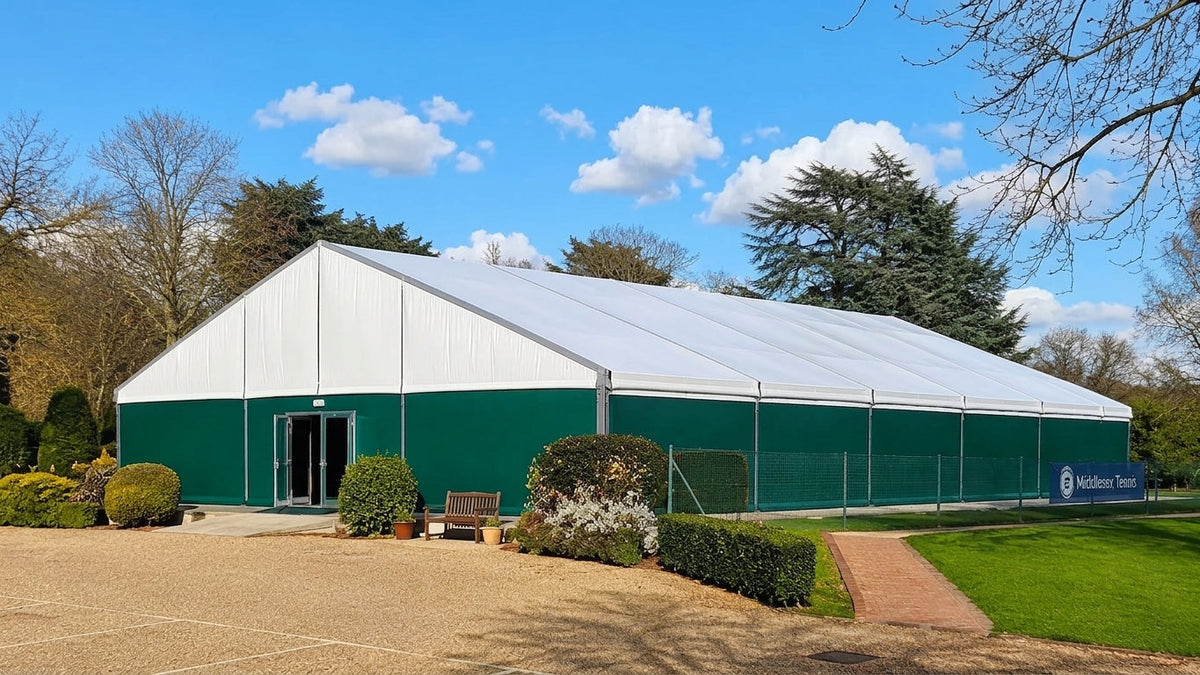
An open-sided canopy sits in between doing nothing and building a hall. It gives you overhead weather protection while keeping the court open on all sides — natural airflow, daylight, and unrestricted access stay exactly as they were. For clubs, schools, hotels and private developments that want to cut weather-related cancellations without the cost and complexity of full enclosure, that's usually the sweet spot.
What the structure is actually made from
-
Frame: heavy-duty 6061-T6 aluminium — a structural-grade alloy, not a decorative-grade one.
-
Connectors: galvanized steel, used specifically at the connection points for strength.
-
Roof membrane: an 850g/m² PVC cover that's waterproof, UV-resistant, flame-retardant, heat-resistant and mildew-resistant, while still letting daylight through underneath.
-
Wall configuration: open front, rear and side elevations — no enclosure, no loss of ventilation.
Sizing: don't just go by the headline dimensions
This is the part that's easy to get wrong. The standard configurations are:
-
Single court: 118ft × 60ft × 29ft (36m × 18m × 8.8m)
-
Double court: 118ft × 118ft × 33ft (36m × 36m × 10m)
-
Triple court: 177ft × 118ft × 33ft (54m × 36m × 10m)
But the quoted structure height isn't the same thing as guaranteed clear playing height everywhere under the roof. Before settling on a configuration, check:
-
The full court footprint, including baseline and sideline runoff
-
Clearance for serves and lobs across the entire playing envelope, not just at the ridge
-
Access routes and entrances
-
Wind and snow design requirements for your specific site
-
Foundation area, ground conditions and drainage
A canopy that looks right on paper can still fall short in practice if the clear height over the baseline hasn't been checked properly.
What actually drives the cost
The listed price is the starting point for the structure itself. The full project cost typically also includes:
-
Delivery and taxes
-
Project engineering
-
Foundations or ground anchoring
-
Unloading and lifting equipment
-
Installation
-
Drainage
-
Permits and other site works
Get a written quotation that spells out exactly what's included and what isn't — this is where budgets tend to drift if it isn't nailed down early.
Planning and permits
Whether you need planning permission or building control sign-off depends on your location, the dimensions you're installing, and how the court will be used. It's worth confirming this — along with what drawings or structural calculations your local authority will want to see — before you order rather than after.
Self-install or professional installation?
Self-assembly is available on selected configurations, but it's not a decision to make lightly. Before choosing that route, be clear on:
-
What the installation manual actually requires
-
Whether you have the labour and lifting equipment on hand
-
Foundation readiness
-
Safety responsibilities and local regulations
Where professional installation is available, a proper quotation should state clearly who's responsible for foundations, unloading, lifting, assembly, drainage, permits and final checks.
The bottom line
A tennis court canopy won't turn an outdoor court into a climate-controlled hall, and it isn't meant to. What it does is protect the court and the players from the weather that currently causes lost bookings — at a fraction of the cost and complexity of a fully enclosed building. Get the clearance, sizing and site requirements right up front, and it's a straightforward way to keep courts usable for far more of the year.
Comparing court cover options? Kit Buildings supplies single-, double- and triple-court tennis canopies in 6061-T6 aluminium with 850g/m² PVC roofing — or see the padel court cover if that's the sport in question.